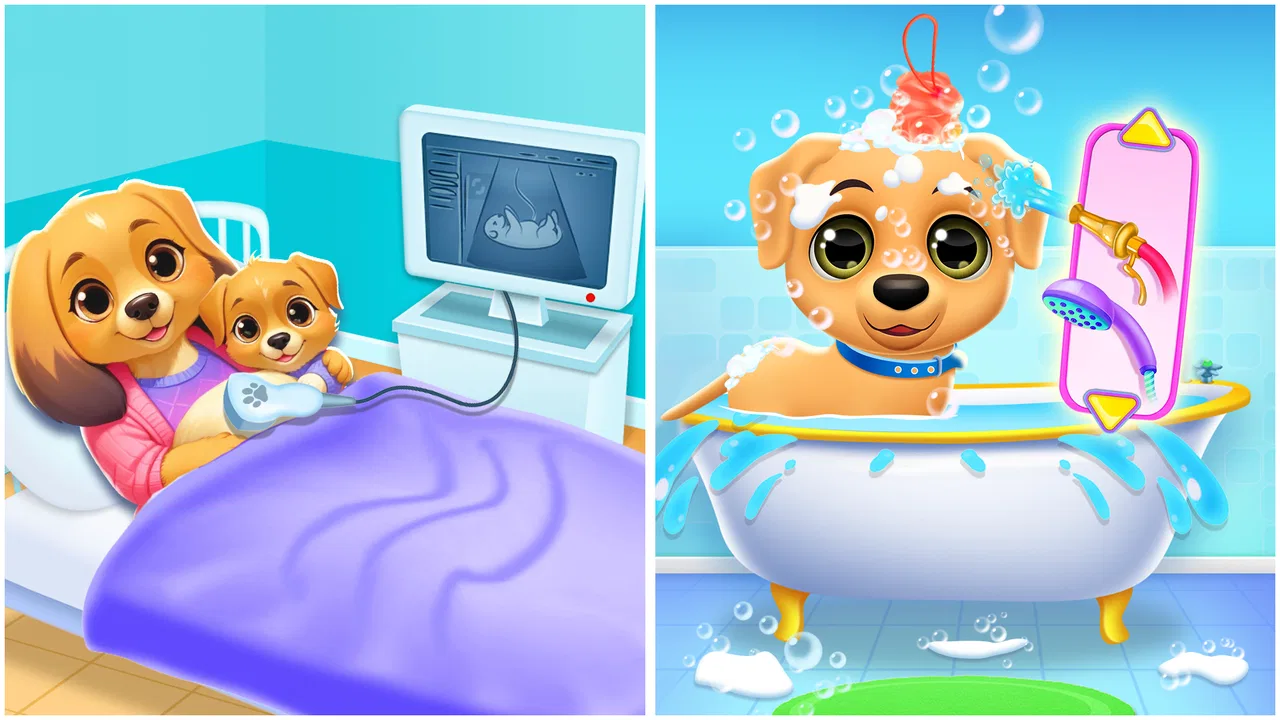
Baby Puppy Game
- 3.9
- Rating
- 1.00M
- Installs
- Free
- Price

 Analysis by App-foxy
I approached Dog Parenting fun Games as a light parenting app with a simple promise: give you a virtual puppy to care for, play with, and pamper. After spending time with it, I found that its main appeal is not deep simulation or a complicated progression system. It is the small routine of checking in on an adorable dog and turning short spare moments into gentle, child-friendly play.
That distinction matters. If you want a serious pet-care simulator with detailed training, realistic behavior, or a large story, this will probably feel too modest. If you want something approachable for a child, a quick distraction during a quiet afternoon, or a relaxed virtual pet experience without an entry cost, it makes more sense. The app is free, aimed at Everyone, and comes from Pi Games Studio.
Its scale is reflected in its audience: the app has passed one million installs and holds a 3.9 average from roughly 1.7 thousand ratings. I would not treat that score as proof that it will suit every family, but it does suggest a reasonably established app rather than an obscure experiment. My overall impression is that the central dog-parenting loop is pleasant, especially when used in short sessions, while the limited depth may become noticeable for older children or adults.
You May Also Like

 Blood Strike: 2.5 Anniversary
Blood Strike’s Loadouts Turn Every Drop Into a Tactical Gamble
A close look at Blood Strike’s custom loadouts: how fast access to signature weapons reshapes its battle royale rhythm, rewards preparation, and narrows the gap between fights.

 Pandora - Music & Podcasts
Pandora’s Music Is Easy to Start, but Harder to Recover
Pandora’s strength is its low-effort path from a seed to a station. Its weak spot is how much confidence it asks you to place in connection, setup, and quiet recovery.

 8 Ball Pool
 Is Built on Rivalries, Rematches, and Routine
A close look at the rivalries, rematches, shared routines, and unanswered safety questions that turn a quick pool match into a persistent mobile community.

 Samsung Music
’s Quiet Strength Is Playing What You Already Own
Its reach comes less from spectacle than from dependable access to a personal library. That simplicity is both the app’s strongest retention engine and its ceiling.

 AccuWeather: Weather Radar
AccuWeather Review: A Quick, Clear Forecast for Everyday Decisions
For everyday plans, the best forecast is the one you can understand quickly. AccuWeather makes rain timing, radar, and local conditions easy to act on, with a few trade-offs.

 Hill Climb Racing
Why Hill Climb Racing Still Turns Crashes Into One More Run
A tiny car, a bumpy hill and one more upgrade: Hill Climb Racing keeps resurfacing because its simple chaos makes every near-miss feel personal.
More From Our News Desk



The virtual puppy routine is the real reason to install it
The most important capability here is the feeling of looking after a puppy. The app places the dog at the center of the experience, so the activities are easier to understand than in many games that begin with menus, currencies, or a long tutorial. You are encouraged to interact with the animal through play and pampering, which gives the experience a clear emotional focus.
In practice, that focus changes how I used it. I did not open it expecting a challenge to master. I opened it to see the puppy, perform a little care, and leave after a few minutes. That makes it suitable for moments when a child needs a calm activity rather than an intense game. It also gives parents a way to introduce the idea of routine care without pretending that a screen-based pet is the same as a real animal.
The strongest part is the immediate, low-pressure connection with the puppy. There is no need to understand a complex rule set before the basic idea becomes clear. A child can recognize that the dog is there to be played with and pampered, and that simple actions are the point of the session. For younger users, that clarity is more valuable than a large number of systems competing for attention.
Still, I would keep expectations realistic. The title suggests fun games, but the verified store information does not present it as a full educational tool or a realistic guide to dog ownership. I would use it as imaginative play, not as a substitute for learning how to feed, exercise, train, or safely handle a real puppy. The virtual routine can start a conversation about responsibility, but the parent has to provide that context.
What the capability feels like during a normal session
My preferred way to use the app was in brief visits rather than one long sitting. I would open it, spend time with the puppy, try the available play or pampering interactions, and stop once the activity began to feel repetitive. That rhythm fits the concept well. The app does not need to become a major daily commitment to be enjoyable.
This also makes it a practical choice for a child who is still learning how to navigate mobile games. The dog gives the interface a clear subject, while the care theme makes the purpose of the interactions easy to explain. Instead of saying, “Try every button and see what happens,” a parent can say, “Let’s see how we can look after the puppy.” That small difference makes shared play more natural.
For adults, the same simplicity can be either a strength or a weakness. I liked that it did not demand strategic planning, but I also noticed that the experience is less satisfying if I want meaningful decisions or a strong sense of long-term progress. The app works best when I accept it as a casual pet activity rather than asking it to behave like a larger management game.
How I would introduce it to a child
I would begin by playing alongside the child instead of handing over the phone immediately. That lets you show the difference between caring for the puppy and simply tapping around the screen. It is also a useful moment to set a session boundary. Because the experience is easy to enter, a child may keep returning to the same interactions even after the novelty has faded.
A simple routine works well: visit the puppy, choose an activity, talk about what the dog might need, and then close the app. This turns the game into a short shared ritual rather than an endless source of screen time. It also avoids presenting the virtual dog as a replacement for real play, outdoor activity, or time with family pets.
One useful tip is to let the child explain what they think the puppy wants before helping. That makes the app more interactive and encourages observation without claiming that the game teaches veterinary or animal-care knowledge. Another is to use the puppy as a prompt for real-world discussion: why dogs need attention, why animals cannot be treated like toys, and why caring for a pet involves work beyond cuddling.
Where the app fits best in everyday life
The best scenario I found is a short, supervised session for a younger child who enjoys animals and wants a friendly activity that can be understood quickly. Imagine a rainy afternoon when outdoor plans are cancelled. A parent can sit with the child, open the app, and spend a few minutes playing with the virtual puppy while talking about what responsible pet care means. The app supplies the imaginative setting; the conversation supplies the depth.
It also fits well as a gentle transition activity. A child might use it briefly after school while waiting for dinner, or during a quiet period when the family needs something less energetic than an action game. Because the store age rating is Everyone, it is positioned as broadly accessible, although I would still supervise younger children and check how they respond to the app’s interaction style.
Another realistic use is for families considering a dog but not yet ready to adopt one. I would not call the app a test of whether a child is prepared for a real pet, because virtual care removes the mess, time pressure, cost, and unpredictability of an animal. However, it can help a child express what they find appealing about having a puppy. That gives parents a starting point for explaining the less glamorous responsibilities that a game cannot reproduce.
The app can also work for children who are nervous around real dogs. A virtual puppy offers distance and control, which may make the idea of interacting with animals feel less intimidating. I would treat that as a possible comfort, not a formal therapeutic benefit. The child can stop whenever they want, and the parent can use the experience to talk gently about animal behavior without forcing contact with a real dog.
How it compares with ordinary alternatives
Compared with a real pet, the advantage is obvious: there is no feeding schedule, cleaning, noise, allergy concern, or responsibility for another living creature. That makes the app convenient and safe as pretend play. The disadvantage is just as important: the puppy cannot teach the emotional and practical demands of real ownership. It is a controlled fantasy, not a rehearsal that covers every part of life with a dog.
Compared with a standard cartoon game, the parenting angle gives this app a clearer purpose. A typical character game may focus on collecting, racing, or completing challenges. Here, the puppy is meant to be cared for and enjoyed. That can feel more soothing, especially for children who prefer animals to competition. On the other hand, children who need constant goals, varied levels, or a strong narrative may find a conventional game more rewarding.
Compared with a more detailed virtual-pet simulator, this app is easier to approach but likely less demanding. I see that as a deliberate trade-off rather than a flaw by itself. A simple experience is better for a child who would be overwhelmed by complicated menus. An older player may prefer an alternative with richer customization, clearer progression, or more substantial consequences for decisions.
The free price also changes the comparison. You can try the app without committing money, which makes it easy to judge whether the puppy routine holds a child’s attention. I would use that opportunity before making it part of a regular family routine. Free access removes a financial barrier, but it does not guarantee that the experience will remain fresh for everyone.
Trade-offs I noticed after the novelty settled
The main limitation is depth. The core appeal comes from interacting with the puppy, and that is pleasant at first, but a child looking for a growing challenge may eventually ask what comes next. If the attraction is primarily the first impression of an adorable dog, interest may drop once the basic interactions are familiar.
That is why I would not install it as the only game on a tablet. It is better as one small option in a broader collection of age-appropriate activities. Pairing it with drawing, reading, outdoor play, or a more structured game keeps the app in its proper role. It is a short-form pet experience, not a complete entertainment ecosystem.
Another trade-off is the difference between emotional language and actual care. The app encourages the child to feel responsible for a puppy, but the consequences are simplified because this is a game. A parent should avoid saying that virtual interactions teach everything needed to own a dog. The better approach is to enjoy the pretend-care element while explaining that real animals have needs that cannot be paused or reset.
I also recommend checking the app personally before allowing independent use. Even with an Everyone content rating, families have different expectations about advertising, prompts, or the amount of supervision a child needs with any free mobile app. I would not assume that an age label answers every household question. A quick parent-led trial is the most sensible way to decide whether the experience feels comfortable on your device.
Device compatibility is fairly approachable: the current version is 75.0 and requires Android 8.0 or later. That means owners of older phones should check the operating system before planning around it. I appreciate that the requirement is not aimed only at the newest devices, but compatibility still depends on the individual phone and how smoothly it handles the app.
Small choices that make the experience better
I found three practical ways to get more value from the app. First, keep sessions deliberately short. The puppy is more appealing when the activity feels like a visit rather than a task that must occupy an entire afternoon. Second, play together at least occasionally so the child connects the virtual actions with a real conversation about kindness and responsibility.
Third, use the app as a choice rather than a reward that is always available. Offering it after homework, reading, or a family activity can give the puppy visit a clear place in the day without letting it become the default response to boredom. This is not a feature hidden in the software; it is a better way to frame a simple game so that its limited depth becomes an advantage instead of a disappointment.
A further tip is to watch for the moment the child starts repeating actions without interest. That is usually the right time to close the app, not to search for a new reason to keep playing. The experience is most successful when it ends while it still feels pleasant. For a parent, recognizing that stopping point is more useful than trying to stretch the game beyond what it offers.
Who will get the most from this puppy-care app
I would recommend it most to younger children who already like dogs, families looking for a gentle casual app, and parents who want to join a child in short, imaginative sessions. It is also a reasonable low-risk download for anyone curious about a virtual pet concept because it is free and broadly age-rated. The developer, Pi Games Studio, has kept the central idea easy to understand, which is exactly what this audience needs.
I would be more cautious for older children who expect complex gameplay. They may enjoy the puppy briefly, but the lack of a demanding challenge could make the app feel shallow. The same applies to adults looking for a serious simulation. If your priority is realistic animal behavior, detailed training, or a long progression path, a dedicated simulation game will probably be a better match.
It is also not the right choice for a family hoping to teach complete dog ownership through an app. The virtual setting can support a discussion, but it cannot recreate the time, cost, patience, and unpredictability involved in caring for a living animal. I would choose an educational resource or a conversation with a qualified professional for practical pet-care guidance, and keep this app in the realm of play.
My final view is positive but measured. Dog Parenting fun Games succeeds when its puppy is treated as the center of a small, friendly routine rather than as the beginning of a deep simulation. I like its approachable concept, free entry, and suitability for shared parent-and-child play. I also think its repetition and modest depth should be acknowledged before installation.
For a quick virtual puppy visit, it is worth trying. For a demanding game, a serious learning tool, or a substitute for real pet responsibility, I would look elsewhere. If you install it with the right expectations and use it as a short conversation starter about caring for animals, the app offers a pleasant little experience that can fit naturally into family downtime.
FAQs for Baby Puppy Game
01What is Dog Parenting Fun Games about?
Dog Parenting Fun Games is an interactive simulation app that allows users to experience the joys and challenges of raising a virtual dog. Players can engage in various activities such as feeding, grooming, training, and playing with their pet, all while learning about responsible pet ownership in a fun and engaging way.
02What features does Dog Parenting Fun Games offer?
The app offers a wide range of features including realistic dog behavior, customizable pet appearances, and various mini-games. Users can train their dog with different commands, participate in virtual competitions, and even connect with other players to showcase their pets. The app also provides helpful tips and advice for real-life dog parenting.
03Is Dog Parenting Fun Games suitable for children?
Yes, Dog Parenting Fun Games is designed to be family-friendly and is suitable for children. The app uses simple controls and colorful graphics to engage young players while teaching them about the responsibilities of caring for a pet. Parental controls and guidance features are available to ensure a safe and educational experience.
04Are there in-app purchases in Dog Parenting Fun Games?
The app does include in-app purchases. These allow players to buy additional items, such as special accessories for their dogs or extra training sessions. While these purchases enhance gameplay, they are not necessary to enjoy the full experience. Parents should be aware of these options and manage them appropriately.
05Does Dog Parenting Fun Games require an internet connection?
Dog Parenting Fun Games can be played offline, but certain features, like connecting with other players or accessing updates and new content, require an internet connection. Playing offline still allows users to enjoy most of the game's core features, making it versatile for different environments.
Pros
- Engaging mini-games for pet care.
- User-friendly interface with cute graphics.
- Educational content on dog breeds.
- Regular updates with new challenges.
- Encourages responsible pet ownership.
Cons
- In-app purchases can be expensive.
- Limited breed selection initially.
- Requires internet for some features.
- Advertisements can be intrusive.
- Gameplay may become repetitive.

Baby Puppy Game
Gallery